Mobilize Active Rehabilitación Awareness - Multimodal Power Training - Centro de Ictus
Traditional tratamiento methods mainly rely on therapists assisting patients to complete passive or power-assisted exercises. Some power-assisted exercises can use equipment or pulleys to provide asistencia to assist the affected side to complete the training. Passive exercises lack verbal communication and action induction, while power-assisted exercises have a single training and password. It’s difficult to mobilize the paciente's awareness of active participation in training. And for hemiplegic patients who have just started mano grasping exercise training, due to abnormal mano sensation and poor motor control, it is difficult to independently complete functional training such as spherical grasping and columnar grasping; and because the fingers are slender, slender, and finely moved, it is also difficult to provide accurate asistencia for mano functional movimiento.
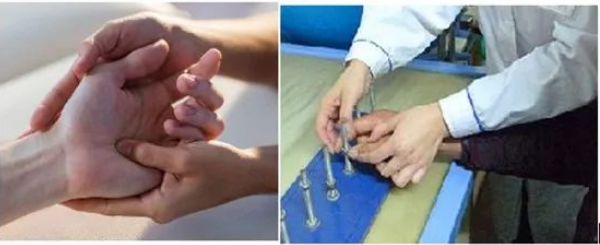
Active rehabilitación training is based on the paciente's wishes, allowing patients to participate in rehabilitación training purposefully. In clinical studies, it has been confirmed that active rehabilitación training can induce functional reorganization of the cortex, which can significantly mejorar the motor función and activities of daily living of ictus patients with hemiplegia compared with traditional rehabilitación training. In clinical practice, there are still many patients with weakened músculo fuerza and músculo tone due to nerve paralysis, making it difficult to perform fully autonomous active exercise training. However, they can perform active assist training, in which the paciente can actively participate, while the passive movimiento of the joint enhances the proprioceptive input and emphasizes the correct movimiento pattern.
Modern robot-assisted training is also common in the rehabilitación of hemiplegia after ictus, but most of them are still based on passive movimiento, and there is a lack of data collection and feedback of patients’ active participation. Clinical studies of rehabilitación medicine have shown that rehabilitación training with active participation of patients' movimiento intention is more effective for the reconstruction of the paciente's nervous system and the recuperación of motor función. Based on the principle of neurorehabilitation, Syrebo™ mano función rehabilitación and evaluation system (hereinafter referred to as "mano función rehabilitación system") innovatively develops progressive asistencia training mode, bilateral mirror training mode, task-oriented training mode, and other multi-modal power-assisted training model.
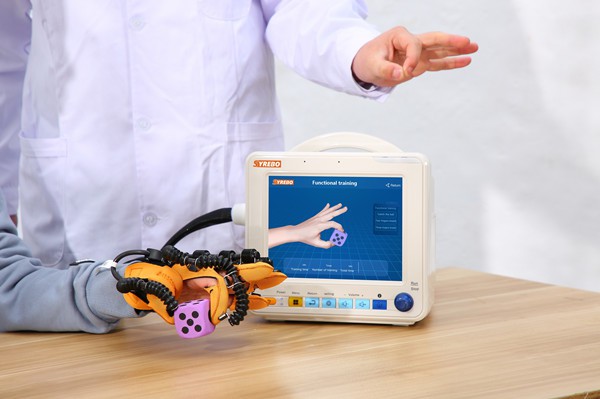
If you want to learn more about this soft rehabilitación robot, please click the following link:
https://www.syrebo.com/info/a-good-helper-for-therapists-application-of-p-69140533.html