A Pilot Study: An Innovative End-effector Haptic Dispositivo Applied in Subacute and Chronic Ictus Patients - Centro de Ictus
Introduction
Ictus is currently the leading cause of long-term disability and is often associated with functional impairment of the upper limbs, which is generally more common than that of the lower limbs. Motor dysfunction of the upper limbs is often associated with other neurological symptoms that hinder the recuperación of motor función and therefore requires systematic and professional therapeutic intervention.
The main goal of ictus rehabilitación is to promote functional recuperación of the damaged limb to maximize functional outcomes and mejorar quality of life. Studies have shown that providing high-intensity terapia and task-specific exercise training combined with robotic and traditional rehabilitación programs can achieve better results. Recent studies have shown that the use of robotics in rehabilitación terapia is well-accepted and well-tolerated in patients with chronic ictus. The current analysis of the mechanism of motor recuperación in ictus patients is only based on clinical outcome measures, while the robotic system can provide different biomechanical data records, such as speed, fuerza, etc., which can be used to analyze and evaluate the recuperación of ictus patients.
The main purpose of this study is to evaluate the effects of upper limb robot-assisted rehabilitación on motor recuperación in ictus patients who underwent tratamiento based on a haptic dispositivo.
Methods
A total of 39 ictus patients (23 subacute and 16 chronic) underwent rehabilitación training by using the novel end-traction upper limb rehabilitación robot. For comparison, 13 healthy subjects were recruited.
The following clinical outcome measures were used: Chedoke-McMaster Ictus Assessment (CMSA), Modified Ashworth Scale (Modified Ashworth Scale, modified Ashworth Scale), and Modified Ashworth Scale (Modified Ashworth Scale, modified Ashworth Scale) were used to evaluate ictus severity. MAS), Fugl-Meyer Assessment Upper Extremity Scale (FMA-UE), Médico Research Council (MRC) method, Médico Research Council (MRC) method, Fugl-Meyer Assessment Upper Extremity Scale (FMA-UE). MRC), Motricity Index (MI), Box and Block test (B&B) and modified Barthel index (MBI).
The following parameters were calculated: mean velocity, maximum velocity, meantime, path length, standardized jitter, mean force, mean error, mean energy expenditure, and percentage of active paciente-robot interactions. Assessments were performed before and after tratamiento.
Results
In Table 3, thirty-nine ictus patients (twenty-three subacute and sixteen chronic) underwent rehabilitación training by using MOTORE/Armotion haptic system. Thirteen healthy subjects were recruited for comparison purposes. The following clinical outcome measures were used: Chedoke-McMaster Ictus Assessment, Modified Ashworth Scale (MAS), Fugl-Meyer Assessment (FM), Médico Research Council, Motricity Index (MI), Box and Block Test (B&B) and Modified Barthel Index (mBI). The following parameters were computed: mean speed, maximum speed, meantime, path length, normalized jerk, mean force, mean error, mean energy expenditure and active paciente-robot interaction percentage. The assessments were carried-out before and after tratamiento.
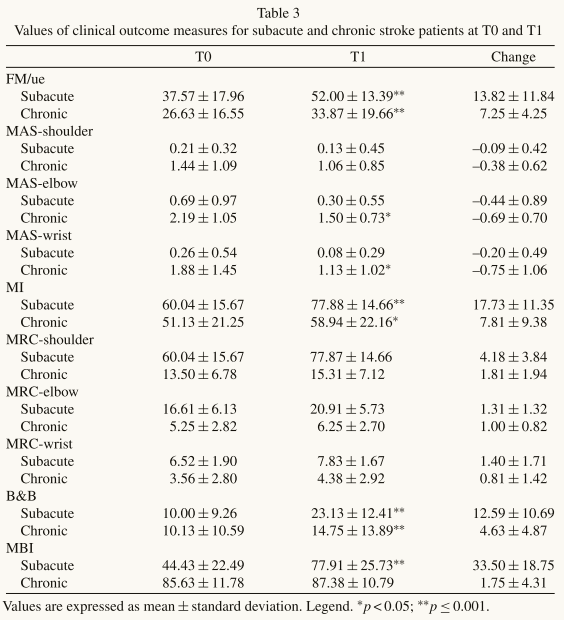
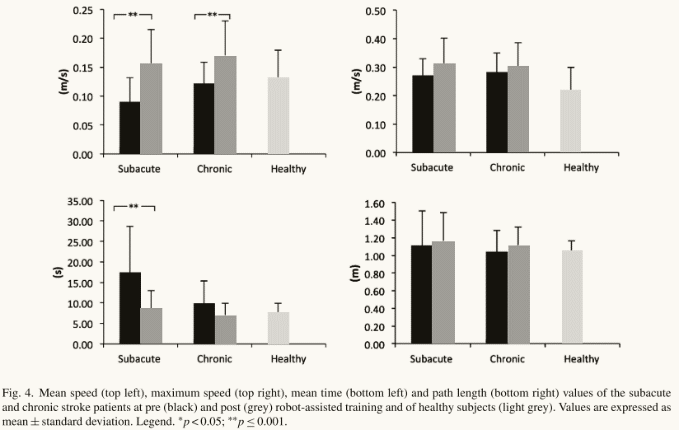
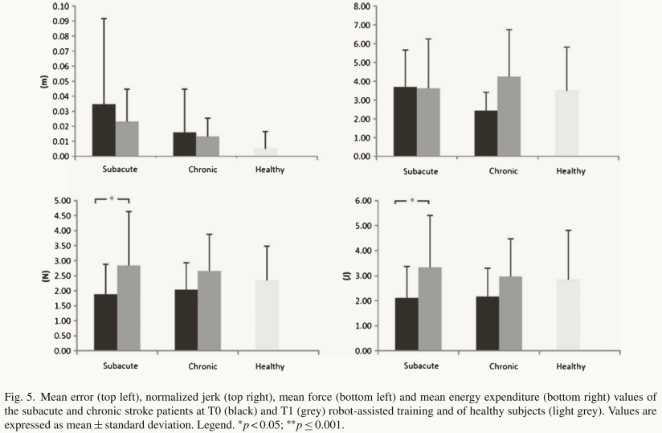
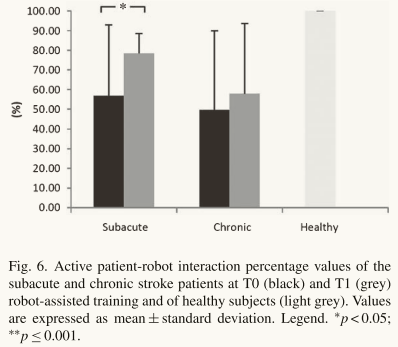
Fig. 4-6 show the results of the kinematic analysis: significant changes in mean velocity were observed in both groups (Fig.4) : In particular, at the end of the tratamiento, patients were able to perform the reaching task at a higher speed than at the beginning of the rehabilitación tratamiento. The maximum velocity and path length (Fig.4) did not change significantly in either group. Significant changes in mean time (Fig.4), mean force, and mean energy expenditure (Fig.5) were observed in the subacute group; Finally, in the subacute group, the percentage of positive paciente-robot interactions increased significantly at the end of robot-assisted terapia, as shown in Fig.6.
Conclusions
In both subacute and chronic patients, the innovative haptic dispositivo used is at least as effective as an existing dispositivo used in similar studies. However, compared to similar haptic devices, the advantages of the novel dispositivo are its lightweight, smaller size, and portability, thus having the potential for use in the home.
Based on the above research background, Syrebo has developed the portable upper limb rehabilitación robot, SY-UEA2, providing a new upper limb rehabilitación method and a more reliable rehabilitación option for the majority of patients.
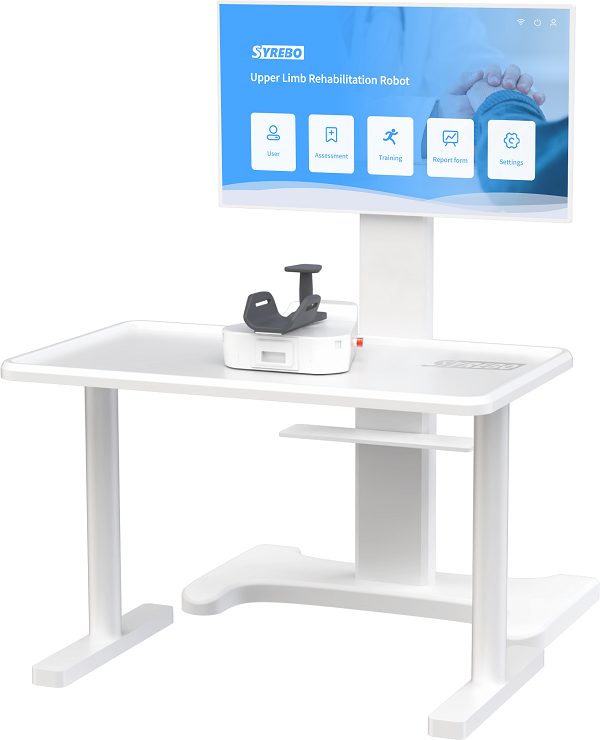
Syrebo upper limb rehabilitación robot adopts a full-featured mobile chassis and high-precision optical positioning technology, providing users with various effective target-oriented training to enhance upper limb fuerza, speed, and accuracy, and reshape upper limb functionality.
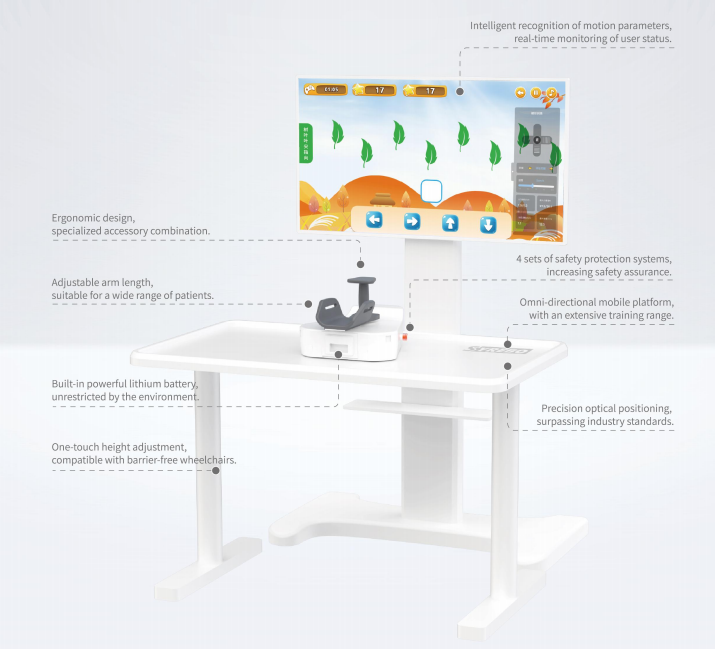
Compared with the traditional upper limb rehabilitación training method, SY-UEA2 adopts advanced motion control technology and high-precision optical positioning sensor technology, which can realize the positioning error <0.03mm, accurately captures the paciente's movimiento state and carries out intelligent movimiento rehabilitación training according to rehabilitación needs. At the same time, it has five advantages, such as integration of training and evaluation, task-oriented scenario interaction, full-cycle coverage of rehabilitación, multi-dimensional synchronous training and multiple safety protection.
Reference: Mazzoleni S, Battini E, Crecchi R, et al. Upper limb robot-assisted terapia in subacute and chronic ictus patients using an innovative end-effector haptic dispositivo: A pilot study. NeuroRehabilitation. 2018;42(1):43-52.